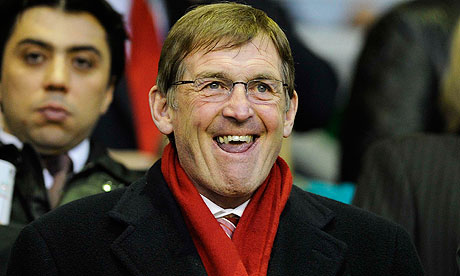
King Kenny. Hope. What's the difference? When Rafa Benitez left Liverpool last week by mutual consent, it began. Nobody likes change at the best of times, but usually a managerial change at a football club is a result of things not going too well. In that respect change is easier to accept as it offers hope. And hope is where we all fall down!
To my memory Benitez and his £6million settlement is probably the most expensive scape goat in town. I'd happily do it for half! That Liverpool finished seventh in the league, dropped out of the Champions League early and failed to reach the final of the Europa League are footballing key performance indicators and commonly used to judge the success of a football club. When they come up short as happened this season, the person accountable for the footballing side of the club is the person with whom the failure is laid. That doesn't really tell the truth, the whole truth and nothing but the truth.
That being the unstable ownership of the club, no clear strategy or direction, debt previously unknown and a changing climate in which the economics of football are played out. A club can not aimlessly pay millions of pounds in transfer fees each season regardless of other non-footballing key performance indicators and rightly so. Liverpool it was reported in the Guardian recently suffered from not heeding that principle even under David Moores and Rick Parry so it is not a new practice that should lay accusingly at the feet of the current owners. Spending within your means is valid on a personal level right through to large corporate organisations to governments and countries. That lesson can be seen wherever you turn today.
One of the many issues that contributed to poor on-field results was that of money. How much and how to spend it. Gareth Barry's protracted non-transfer, Rick Parry's departure and Rafa's new contract are all examples of that. One of the clearest mantras a manager in any business can have is 'no surprises'. Ability means you can manage with what you have, so long as you know what you have in a timely manner. That Benitez was perceived to have spent poorly in the transfer market was not a measure of his ability but more an outcome of the lack of timeliness in agreeing what funds were available. A fact that seems lost amongst poor results and a slide down the league table.
So how does all that relate to hope? As a manager sets out the philosophy, identity, values and beliefs of a team he or she managers, then new manages bring about revolutionary change. And if, as is often the case, the old manager left because things were bad, then revolutionary change by default is good, yes?
That leads to hope that things will be better in the future. Sometimes it is, often it isn't. Hope is currently what is fuelling media speculation and more generous journalism. Reality hasn't yet had it's chance. And when it does...?
The reality for Liverpool tempers hope. Same owners, same debt. Same players since no money is available to reshape the team. Less money as there will be no Champions League revenue. So who'd want the job? Speculation in this area is endless but misses the point. Look more closely at Benitez's departure and the clues are there.
Who sacked him (mutually of course!)? Martin Broughton, the new Chariman. And why is Broughton at the club? At the behest of the owners to sell the club. So why is someone who is trying to sell the club sacking the current manager? It would appear there is sufficient circumstantial evidence to suggest in parting with Benitez he was going about his business of selling the club.
If new owners wanted Benitez gone it could have cost £16m. New ownership and new money and Benitez probably would have not taken the £6m compromise. Benitez was also hugely powerfull: first team manager, overseer of the reserves and the academy and solely in charge of transfers. All of which have been shaped in his image. A change of owners and a change of approach and that is a large, well paid obstacle in the way!
So maybe Broughton let Benitez go to satisfy potential buyers waiting in the wings. Or maybe just to get his house in order before attracting investment. Either way it seems it was done for a purpose. Which brings us once again to the issue of hope.
If the above theory is correct, why would Liverpool appoint a manager before selling the club? Unless prospective owners have identified the person they wish to take over? A more sensible tactic would be to appoint someone in the interim. Someone to carry on the work of Benitez without the investment required in huge personnel changes. In my opinion this would be where Sammy Lee would step forward. The media are focusing on King Kenny but I am fairly confident Sammy would be the chosen one, probably mentored or supported in an executive capacity by Dalglish. Keeps things neat, tidy and cheap, and the seat warm for someone else in the future.
Reality versus hope. Who wins? You decide!